
Mind Map Mastery for the Neurodiverse Brain
A Practical Mind Mapping Book for Neurodiverse Learners
About the Book
The education system was built for linear thinkers.
But not all brilliant minds think in straight lines.
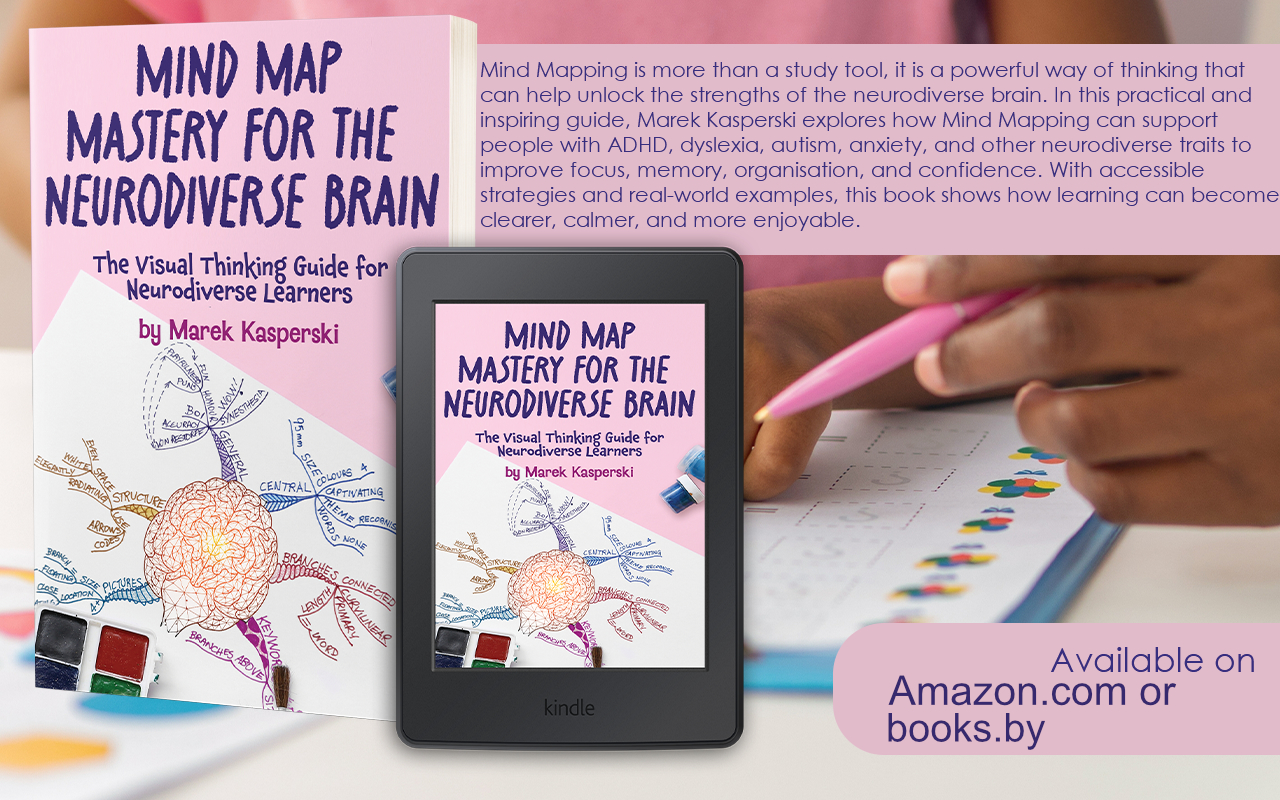
In Mind Map Mastery for the Neurodiverse Brain, internationally respected Mind Mapping educator, Professor Marek Kasperski, presents a bold and transformative approach to learning, one that aligns with how many neurodiverse individuals naturally process the world.
Drawing on decades of teaching experience across cultures and age groups, Kasperski reveals how radial, visual thinking can:
• Reduce cognitive overload
• Support focus without force
• Strengthen memory through meaning and imagery
• Improve organisation and executive function
• Transform anxiety into structured clarity
This book does not offer medical diagnosis or therapeutic claims.
Instead, it provides a powerful educational framework grounded in neuroscience principles, visual cognition research, and real classroom application.
A Revolutionary Visual System for Unlocking Focus, Clarity and Learning Power

About the Author
Professor Marek Kasperski, a close friend and long-time collaborator of Tony Buzan, the inventor of Mind Mapping, received personal training and mentorship directly from Buzan himself.
Drawing on this unique foundation and decades of practical experience, Marek has taught Mind Mapping to more than 23,000 people worldwide, including over 5,000 school students.
The Mind Map Mastery book series distils this expertise into a practical and engaging learning resource, empowering students of all ages and backgrounds to enhance their thinking, learning, creativity, and academic performance while unlocking their full potential.
Chapters and Sub-Chapters
The Neurodiverse Brain Doesn’t Need to be Fixed
A Word of Caution from the Author
Sometimes a single glance can change your perspective
Your Brain Doesn’t Learn from Lines
The Illusion of Copying
Hidden Patterns in the Margins
The Intelligence of Visual Thinking
Mind Mapping: The Power of the Brain on Paper
Powerful Lessons from the Margins
Mind Maps Help Your Brain Learn Better
Mind Mapping Can Change Your Perspective
How to Unlock Your Brain’s True Potential
The Incredible Capacity of the Human Brain
The Three Dominant Styles of Note-Taking
The Hidden Consequences for Learners
Why Mind Maps Work
The Brain Begins to Flourish
Let’s Move Forward
The Mind Map
Change the Tool, Change the Thinking
The Brain Prefers Patterns
Keywords: Reducing Cognitive Overload
The Power of Colour and Images
A Different Way of Seeing the Same Learner
Creativity and Structure Together
From Struggle to Strength
The Future of Neurodiverse Learning
Start With Curiosity, Not Rules
Begin With One Simple Mind Map
Encourage Keywords, Not Sentences
Use Colour to Capture Attention
Invite Images and Symbols
Create a Safe Space for Imperfection
Allow Movement and Energy
Celebrate the Diversity of Thinking
From Learning Tool to Thinking Skill
Key Teaching Principles
A Tool for Empowerment
A Necessary Pause
- Cognitive Load Theory: Reducing Unnecessary Strain
- Dual Coding Theory: Words + Images Strengthen Memory
- Executive Function and External Scaffolding
- Retrieval Practice and Active Recall
- Motivation and Autonomy
- Emotion and Cognitive Performance
- Neurodiverse-Specific Research: What We Know
- What the Research Does NOT Claim
- Evidence-Informed, Not Evidence-Exaggerated
- Where Future Research Is Needed
A Balanced Conclusion
A Conversation Worth Having
The Difference Between Support and Treatment
Why Overclaiming Is Harmful 44
What the Research Actually Supports
Why “Not a Cure” Is Actually Empowering
The Power of Environmental Change 45
Staying Within Our Role as Educators
Language Matters
A Motivational Reframe
The Ethical Promise of This Book
A Conversation Worth Having
The Difference Between Support and Treatment
Why Overclaiming Is Harmful
What the Research Actually Supports
Why “Not a Cure” Is Actually Empowering
The Power of Environmental Change
Staying Within Our Role as Educators
Language Matters
A Motivational Reframe
The Ethical Promise of This Book
The Associative Brain
Visual Thinking and Dyslexia
Pattern Recognition and Systems Thinking
Creativity and Divergent Thinking
Reduced Working Memory Demands
Engagement Through Active Learning
From Difference to Advantage
A Different Way to See Intelligence
Unlocking Hidden Potential
Key Insights
A Different Starting Point
The Myth of the “Standard” Brain
Working Memory and Cognitive Load
Visual and Spatial Processing Strengths
Executive Function: The Hidden Conductor
Sensory Processing and Learning Environment
Emotion and Learning
Big Picture vs Sequential Thinkers
A Foundation for Visual Learning
The Quiet Struggle No One Sees
The Legacy of Linear Learning
Linear Notes: When Structure Becomes Constraint
Dense Text and Cognitive Overload
Passive Listening: The Illusion of Engagement
The Emotional Toll of Repeated Friction
The Hidden Inefficiency
When Method Becomes the Barrier
A Different Possibility
Welcome to Your Most Powerful Tool Ever
Beyond Labels: Rethinking Intelligence
The Brain Is Not Fixed – It Is Alive
The Scale of Your Potential
Pattern Recognition: Your Brain’s Superpower
The Creativity Advantage
Practical Ways to Activate Your Brain’s Amazing Potential
The Bigger Picture
You Are Brilliant
Introduction
The Central Image
Law 1: Curved Branches
Law 2: Keywords
The Power of Keywords: A Thought Experiment
My Personal Experience in Guangzhou, China
What We Can Learn From This Story?
Law 3: Colour
How to use Colour Effectively
The Psychology of Colour
Law 4: Images
Why Images Really Work
A Practical Example
Law 5: Structure
Five Tips for Creating a Strong Mind Map Structure
Getting Ready to Create Your First Mind Map
Choosing the Right Tools
Setting Up Your Workspace
Getting into the Right Frame of Mind
Step 1: Start with a Blank Page
Step 2: Selecting Colours and Developing Your Branches
Step 3: Adding Keywords
Step 4: Adding Secondary-Level Branches
Step 5: Expanding with Radiating Branches
Step 6: Adding Additional Primary Branches
Step 7: Connecting Ideas Across Your Mind Map
Part IV How the Brain Responds to Mind Maps
Ca
The Moment Everything Clicks
The Brain Is a Pattern-Seeking Organ
Why Structure Calms the Mind
Colour: More Than Decoration
Meaning: The Brain’s True Priority
Visual Organisation and Dual Coding
Spatial Memory: The Forgotten Strength
From Chaos to Coherence
Motivation Through Visibility
Why This Matters for Neurodiverse Learners
Visual organisation offers alignment
The Deeper Principle
A Foundation for What Comes Next
“I See It Before I Can Say It”
Words Are Recent. Images Are Ancient
When Words Get in the Way
Dual Coding and the Power of Images
Pattern Recognition: A Hidden Strength
The Emotional Impact of Visual Fluency
Seeing the Whole Before the Parts
A Story of Recognition
Visual-Spatial Thinking and Mind Map Mastery
Reframing Intelligence
When the Page Feels Too Heavy
Understanding Cognitive Load
Why Linear Systems Increase Load
Radial Thinking: A Natural Alternative
How Radial Thinking Reduces Extraneous Load
The Emotional Effect of Reduced Load
From Fragmentation to Integration
A Story of Shift
Radial Thinking and Neurodiverse Strengths
The Motivational Shift
The Myth of “Just Try Harder”
Just Imagine…
Understanding Attention as a Brain System
Why Passive Learning Drains Attention
Engagement Is the Gateway to Focus
Structure Reduces Mental Wandering
Movement Supports Regulation
Flow: When Focus Feels Effortless
From Compliance to Ownership
A Shift in Perspective
The Confidence Effect
The Deeper Promise of Mind Map Mastery
Mind Maps for Summarising Books
Creating a Book Summary Mind Map
Mind Maps for Learning
Mind Maps for Brainstorming
Understanding Dyslexia in Plain Terms
Meaning Before Mechanics
Why Keywords Matter
Reducing Fear of the Page
Executive Function and Organisation
From Remediation to Empowerment
Writing as Translation, Not Creation
A More Compassionate Order
The Broader Implication
Start With Strength, Not Struggle
The Core Principle: Meaning Before Spelling
Step 1: Model the Process Visually (Do Not Explain Too Long)
Step 2: Use a Familiar, Low-Stakes Topic
Step 3: Teach the Power of Keywords
Step 4: Encourage Imagery Over Accuracy
Step 5: Keep Branches Curved and Spaced
Step 6: Build Structure Before Detail
Step 7: Transition to Academic Content Gradually 143
Step 8: Use Mind Maps Before Writing
Step 9: Separate Editing From Creating
Step 10: Celebrate Clarity, Not Perfection
Why This Works
The Bigger Transformation
Mind Mapping and ADHD: Structure That Liberates Energy
Understanding ADHD Beyond the Label
Why Traditional Methods Drain Energy
The Power of Visible Structure
Immediate Feedback and Momentum
Movement as Regulation
Reducing Cognitive Overload
Interest-Driven Focus and Creativity
From Chaos to Channelled Energy
Practical Classroom Strategies
A Strengths-Based Reframe
The Bigger Transformation
A 20-Day ADHD Mind Mapping Classroom Plan
Introduction: Build the Habit, Not Just the Skill
WEEK 1: Engagement Before Academics
WEEK 2: Introducing Academic Content
WEEK 3: Executive Function Support
WEEK 4: Independence and Mastery
Why This 20-Day Plan Works
Understanding Autism Through a Strengths-Based Lens
Why Unstructured Learning Can Increase Anxiety
The Power of Visible Patterns
Predictability as a Foundation for Calm
Supporting Deep Focus
Reducing Verbal Overload
Sensory Considerations
Executive Function and Task Initiation
Emotional Safety Through Clarity
Encouraging Autonomy
Practical Strategies for the Classroom
From Overwhelm to Order
A Strengths-Based Reframe
The Bigger Transformation
“I Know What to Do… I Just Can’t Start.”
What Are Executive Functions?
Why Traditional Learning Increases Executive Strai
Externalising the Invisible
Task Initiation: Overcoming the Blank Page
Breaking Complexity into Manageable Units
Supporting Working Memory
Time Management Through Visual Planning
Building Metacognition
Practical Classroom Strategies
Understanding Anxiety in Learning
Why Large Tasks Trigger an Overwhelming Feeling
The Power of Visible Boundaries
Externalising Racing Thoughts
Regulating Emotion Through Structure
Practical Classroom Strategies
The Bigger Transformation
The Reality of the Modern Classroom
Moving Beyond “One-Size-Fits-All”
Establishing a Shared Structure
Differentiation Within the Same Mind Map
Managing Cognitive Load for Everyone
Encouraging Multiple Expression Styles
Classroom Routine: Predictable Implementation
Addressing Resistance
Group Mind Mapping for Collaboration
Assessment and Feedback
Supporting Inclusion Without Singling Out
From Teacher-Led to Student-Led
The Deeper Cultural Shift
The Bigger Picture
The Homework Battlefield
A Shift in Role: From Supervisor to Supporter
Why Evenings Amplify an Overwhelming Feeling
Practical Strategy 1: Start With a “What Do We Know?” Mind Map
Practical Strategy 2: Break Tasks into Visible Steps
Practical Strategy 3: Use Mapping for Emotional Regulation
Practical Strategy 4: Mind Map Before Writing
Practical Strategy 5: Use Colour to Create Calm
Practical Strategy 6: Make Mind Mapping Short and Positive
Protecting the Parent–Child Relationship
A Long-Term Skill, Not a Short-Term Fix
Why Exams Feel Stressful
The Problem with “Study Week”
A Better Approach to Revision
A Practical Study System
Sleep and Its Role in Learning
Calming the Mind
The Impact of Blue Light
Managing Screen Exposure
Why Sleep Matters
The Truth About Cramming
Planning for Success
On the Day of the Exam
Using Mind Maps for Final Review
Staying Calm and Focused
Building a Positive Mindset
Just Before the Exam
Nutrition Matters
Meditation
The Neurodiverse Brain and Visual Thinking
Why Art Matters to the Brain
The Central Image as Emotional Anchor
Mindfulness, Attention, and Flow States
Sensory Regulation and Emotional Safety
The Importance of Personal Meaning
Important Limitations and Ethical Considerations
Future Possibilities for Research
A New Understanding of Mind Mapping
A Case Study from China
Sun Meng’s Thoughts on the Mind Map of Art Therapy
The Child in the Classroom
What We Have Learned
Beyond Fixing, Toward Designing
Structure Is Not Restriction
Confidence: The Quiet Outcome
The Role of Teachers and Parents
The Responsibility of Precision
The Future of Learning
The Invitation
Final Thoughts
Rule 1: Start With a Strong Central Image
Rule 2: Use Branches That Radiate Outward
Rule 3: Use One Keyword Per Branch
Rule 4: Use Curved Branches
Rule 5: Use Colour Generously
Rule 6: Include Images and Symbols
Rule 7: Develop Sub-Branches for Details
Rule 8: Keep the Mind Map Clear and Spacious
Rule 9: Make the Map Personal
Rule 10: Engage Your Whole Brain
Bringing the Rules Together
A Tool for Lifelong Thinking
A Diversity of Minds
The Cost of Misunderstood Potential
Discovering a Better Fit
Confidence Through Understanding
A World That Needs Different Minds
From Limitation to Strength
The Purpose of This Book
Remember This
References