
Overview
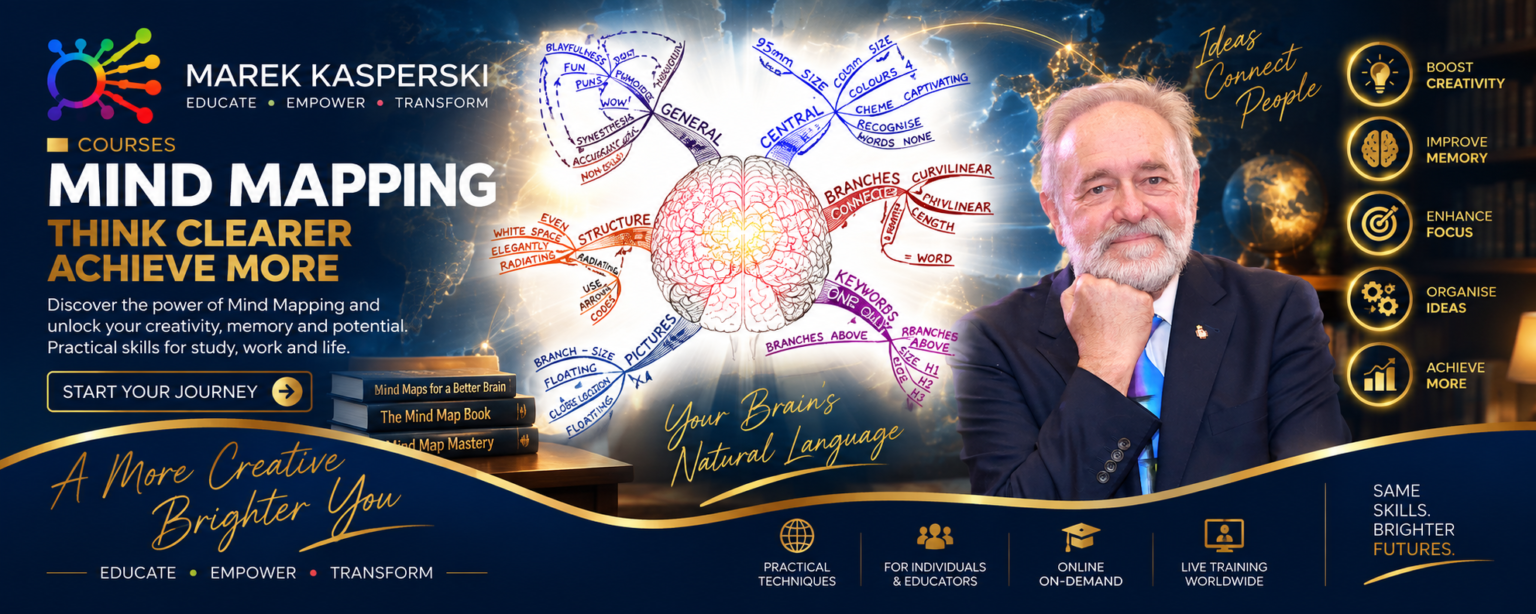
 Mind Map Mastery for the Neurodiverse Brain is a comprehensive and practical course designed to help learners understand how the brain naturally processes information and how visual learning techniques can significantly improve thinking, learning, memory, organisation, and creativity. Based on the internationally recognised Mind Mapping methodology developed by Tony Buzan, the course provides participants with a powerful framework for transforming the way they learn, study, plan, and communicate.
The course explores the limitations of traditional linear note-taking and conventional educational approaches, which often fail to accommodate the diverse ways in which people think and learn. Particular emphasis is placed on understanding neurodiversity and recognising that many learners, including those with ADHD, autism spectrum conditions, dyslexia, anxiety-related learning challenges, and other cognitive differences, may benefit from learning strategies that align more closely with the brain’s natural preference for patterns, associations, imagery, and visual structure.
 Throughout the program, participants examine the science behind learning, memory, attention, cognitive load, and pattern recognition. They learn why visual thinking is such a powerful tool for understanding complex information and how Mind Maps can be used to reduce overwhelm, increase engagement, improve retention, and support executive functioning skills.
The course provides detailed instruction in the principles and techniques of effective Mind Mapping, including the Five Laws of Mind Mapping: the use of curved branches, keywords, colour, imagery, and hierarchical structure. Learners develop practical skills through guided activities that demonstrate how to create clear, meaningful, and memorable Mind Maps for a wide range of purposes.
 Participants are introduced to applications of Mind Mapping across educational, professional, and personal settings. These include note-taking, studying, exam preparation, brainstorming, project planning, report writing, book summarisation, problem-solving, productivity, and decision-making. The course also explores the role of Mind Mapping in creativity, emotional regulation, self-expression, and reflective thinking, highlighting its value as both a cognitive and personal development tool.
A dedicated section focuses on the application of Mind Mapping for neurodiverse learners and the ways in which visual learning strategies can support confidence, independence, and strength-based learning. Additional content is provided for educators, trainers, parents, and learning support professionals who wish to teach Mind Mapping effectively and create psychologically safe learning environments that encourage curiosity, creativity, and learner autonomy.
 By the conclusion of the course, participants will possess a thorough understanding of Mind Mapping theory and practice and will be able to confidently apply Mind Mapping techniques to support learning, communication, organisation, and innovation. They will leave with a practical lifelong skill that can be used to unlock potential, enhance performance, and foster a more positive and empowering relationship with learning. The course promotes the view that different ways of thinking are not limitations to be overcome but valuable strengths that can be developed and harnessed for success in education, work, and life.
Total Training Time.
12 hours 11 minutes
Topics
 Languages.
English
Format.
xxxx Video Sessions – available 24/7 On-Demand


